


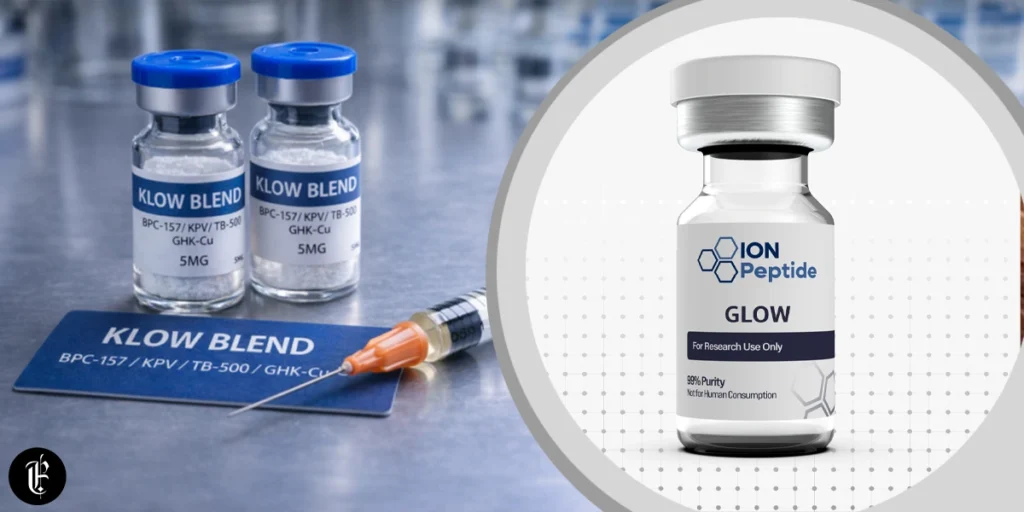
GLOW and KLOW are multi-peptide formulations, consisting of the same set of three primary components. In the common comparison, GLOW consists of GHK-Cu, BPC-157, and TB-500, while KLOW consists of the three components plus KPV.
Thus, the basic difference is that GLOW is the three-component formula, whereas KLOW includes an additional fourth component, which is known in inflammation and epithelial barrier studies.
Comparing GLOW and KLOW on the basis of the information from marketing texts is a bit problematic, since most studies deal with separate peptides or thymosin beta-4 biology (TB-500) rather than with the combination of the peptides, such as GLOW or KLOW. Hence, neither GLOW nor KLOW can be regarded as clinically tested formulas just because their components have already been studied separately.
In this guide, we will explore the differences between GLOW and KLOW in terms of their components’ function and benefits.
Research notice: This article is for educational and scientific discussion. It does not provide medical advice, dosing instructions, or a recommendation for human use. Peptide blends sold as research products may not be approved medicines, and their composition can vary between suppliers.
Quick Comparison
In the reference formulation supplied for this comparison, the blends contain the following amounts per vial:
| Component | GLOW | KLOW | Main research area |
|---|---|---|---|
| GHK-Cu | 50 mg | 50 mg | Copper binding, extracellular matrix, collagen and skin-remodeling research |
| BPC-157 | 10 mg | 10 mg | Tissue integrity, vascular signaling and preclinical repair models |
| TB-500 | 10 mg | 10 mg | Actin-related activity, cell migration and tissue-remodeling research |
| KPV | Not included | 10 mg | Inflammatory signaling, peptide transport and epithelial-barrier research |
| Total components | 3 | 4 | KLOW introduces one additional research variable |
The shared components are present at the same stated concentrations in both reference blends. KLOW does not contain a higher amount of GHK-Cu, BPC-157, or TB-500. It simply adds KPV.
This is important because KLOW should not be described as a stronger version of GLOW. It is better understood as a broader and more complex formulation.
What Is GLOW?
GLOW is generally described as a blend of GHK-Cu, BPC-157, and TB-500. These components are grouped because their research profiles overlap in areas such as extracellular-matrix activity, cellular migration, vascular responses, and tissue remodeling.
GHK-Cu gives the blend its strongest connection to skin and matrix research. BPC-157 is commonly discussed in relation to experimental repair and vascular-response models. TB-500 is associated with actin-related processes and cell movement.
Together, these three components create a relatively focused multi-peptide framework. Researchers interested in studying the shared trio without introducing KPV may find GLOW conceptually easier to interpret.
That does not make GLOW a simple experiment. Any three-component formulation still contains several active variables. A change observed in a model cannot automatically be assigned to one peptide, and the ingredients may interact in ways that have not been fully characterized.
What Is KLOW?
KLOW contains the same core components as GLOW but adds KPV, a tripeptide composed of lysine, proline, and valine.
KPV is derived from the C-terminal portion of alpha-melanocyte-stimulating hormone. Experimental studies have examined its effects on inflammatory signaling, including NF-κB-related activity, and its transport through PepT1 in intestinal epithelial models. Animal research has also investigated KPV in models of intestinal inflammation.
Because of KPV, KLOW extends the blend beyond the matrix, vascular, and structural themes usually associated with GLOW. It adds a distinct interest in inflammatory conditions, mucosal biology, and epithelial-barrier pathways.
That broader scope may be relevant when KPV is directly connected to the research question. It also introduces another variable, making it harder to interpret which component—or combination of components—produced an observed effect.
The Shared Foundation
The most useful way to understand KLOW vs GLOW is to examine the three ingredients they share.
GHK-Cu
GHK is a naturally occurring tripeptide that can bind copper ions to form GHK-Cu. It has been studied for its involvement in tissue remodeling, extracellular-matrix regulation, collagen activity, fibroblast function, and wound-related biological processes.
Reviews of the scientific literature describe GHK-Cu as influencing collagen, elastin, glycosaminoglycan synthesis, metalloproteinases, and several repair-related pathways. Some human work has examined topical copper-peptide preparations, but findings from topical cosmetic or dermatological research should not be automatically extended to injectable use or to multi-peptide blends.
This distinction matters. GHK-Cu may have a recognizable place in cosmetic ingredient research, but a product containing injectable GHK-Cu is a different formulation with a different safety question.
The FDA notes that compounded injectable products containing GHK-Cu may carry immunogenicity concerns related to aggregation and peptide impurities, while human safety data for injectable routes remain limited.
BPC-157
BPC-157 is a synthetic 15-amino-acid peptide widely promoted for recovery and tissue repair. Its popularity, however, has moved considerably faster than its human evidence base.
Published reviews describe experimental findings involving angiogenesis, fibroblast activity, nitric-oxide pathways, collagen formation, and healing in gastrointestinal, tendon, ligament, muscle, and bone models. Much of this evidence comes from laboratory or animal studies, often produced by a relatively small group of researchers.
Human investigation is still limited. ClinicalTrials.gov lists early human research, including a Phase I safety and pharmacokinetic study and a more recent Phase II study involving acute hamstring injury. The existence of registered studies means the compound is being investigated; it does not establish that it is safe or effective for routine clinical use.
The FDA has stated that compounded BPC-157 may present immunogenicity and peptide-characterization risks and that available safety information is insufficient to determine whether proposed uses could harm humans.
TB-500
TB-500 is frequently discussed as though it were interchangeable with full-length thymosin beta-4, but that description can be misleading.
Thymosin beta-4 is a naturally occurring 43-amino-acid peptide and an important actin-sequestering protein. Research has connected it with cell migration, angiogenesis, wound repair, vascular development, and tissue remodeling.
Commercial TB-500 is generally identified as a shorter fragment related to thymosin beta-4 rather than the entire 43-amino-acid molecule. WADA research has identified the active content associated with TB-500 as the acetylated LKKTETQ fragment. Evidence about full-length thymosin beta-4 should therefore not be presented as direct proof that a commercial TB-500 product has the same activity, exposure profile, or safety characteristics.
The FDA reports that it has not identified human exposure data for drug products containing the TB-500 fragment and lacks sufficient information to determine whether it would cause harm. The agency also highlights possible immunogenicity, aggregation, and peptide-impurity concerns.
What KPV Adds
KPV is the defining difference in the KLOW vs GLOW comparison.
Its inclusion adds several research dimensions that are not directly represented by the other three components.
NF-κB signaling: NF-κB is a family of transcription factors involved in inflammatory and immune responses. Experimental work has found that KPV can suppress aspects of NF-κB signaling in airway epithelial models.
PepT1 transport: PepT1 is a transporter involved in the uptake of dipeptides and tripeptides. In cellular and animal models, researchers have investigated whether PepT1 helps transport KPV into intestinal epithelial and immune cells.
Epithelial and intestinal models: KPV has been studied in mouse models of colitis and in research involving epithelial inflammatory responses. These findings make it scientifically interesting, but they remain preclinical and cannot establish effectiveness in people.
KPV therefore gives KLOW a broader theoretical profile. It does not prove that KLOW produces better results, nor does it establish that combining KPV with GHK-Cu, BPC-157, and TB-500 creates a safe or beneficial formulation.
The FDA states that it has not identified human exposure data for drug products containing KPV through any route and lacks key information needed to determine its human safety.
Main Differences
The ingredient lists make KLOW and GLOW look very similar, but the extra component changes several aspects of the research design.
| Factor | GLOW | KLOW |
| Shared peptide base | GHK-Cu, BPC-157 and TB-500 | GHK-Cu, BPC-157 and TB-500 |
| Additional component | None | KPV |
| Number of variables | Three | Four |
| Matrix-related research | Included | Included |
| Vascular and cellular signaling | Included | Included |
| Actin and migration research | Included | Included |
| KPV-related inflammatory signaling | Not included | Included |
| Epithelial-barrier dimension | Not included | Included |
| Interpretation | Relatively narrower | Broader but more complex |
The practical difference is not that GLOW repairs one thing while KLOW repairs another. Both contain the same base trio and therefore overlap substantially.
The question is whether the experiment requires KPV. When it does not, adding KPV may introduce complexity without answering a relevant question. When it does, GLOW cannot provide that fourth research variable.
Which Blend Fits the Goal?
For a project centered on GHK-Cu and extracellular-matrix activity, either formulation contains the same stated amount of GHK-Cu. KLOW offers no automatic advantage unless KPV is also relevant.
For research involving BPC-157-related signaling, both blends contain the same stated amount. Again, choosing KLOW would add KPV rather than increase BPC-157 exposure.
For models focused on actin regulation or cell migration, both include TB-500 at the same stated concentration. Researchers should still distinguish carefully between evidence on commercial TB-500 fragments and evidence on full-length thymosin beta-4.
For research specifically involving KPV, inflammatory signaling, PepT1 transport, or epithelial barriers, KLOW is the relevant blend because GLOW does not contain KPV.
For a simpler multi-component design, GLOW is the more restrained option. It still contains three variables, but it avoids adding a fourth pathway.
For a broader exploratory design, KLOW may cover more biological territory. The trade-off is that broader coverage makes clean interpretation harder.
In some cases, neither blend may be the best design. When the objective is to isolate the mechanism of one compound, studying a single peptide with suitable controls is generally more informative than beginning with a three- or four-component mixture.
Evidence Limits
The largest weakness in claims about KLOW and GLOW is the gap between ingredient-level research and blend-level evidence.
A study showing that GHK-Cu affected fibroblasts does not prove that a blend containing GHK-Cu, BPC-157, and TB-500 will produce the same result. A mouse study involving KPV does not demonstrate that KLOW is effective in humans. Research on full-length thymosin beta-4 does not automatically validate a shorter TB-500 fragment.
The finished blends may also behave differently from their components. Concentration, stability, degradation, pH, excipients, route of exposure, impurities, and interactions can all affect experimental outcomes.
Most importantly, neither blend has been established as a combined therapy through controlled human clinical trials. Claims that one blend reliably heals injuries, improves skin, treats inflammation, or repairs the gut go beyond what current blend-level evidence can support.
Product Quality
Commercial blend names are not necessarily standardized. One seller’s GLOW or KLOW may use different amounts, salts, excipients, or testing procedures from another seller’s product.
A total milligram figure is not enough. The label should identify:
- The exact amount of each component
- The chemical form used
- The batch or lot number
- The testing date
- The testing laboratory
- The analytical methods
- The storage instructions
A certificate of analysis can be useful, but it should not be treated as a guarantee. A meaningful certificate should be batch-specific and traceable to the vial received. It should also show what was tested.
HPLC can provide information about purity or separation, while mass spectrometry may help confirm molecular identity. Neither method alone establishes sterility, endotoxin control, biological activity, or clinical safety.
This is especially important for injectable preparations. A product can have a high chemical-purity figure and still present risks from contamination, endotoxins, aggregation, incorrect concentration, or unsuitable manufacturing conditions.
Safety and Regulation
Research labeling does not make a product safe for personal experimentation. Phrases such as “research use only” usually indicate that a product is not being sold as an approved medicine.
In the United States, compounded drugs are not FDA-approved. The FDA does not verify their safety, effectiveness, or quality before marketing in the same way it reviews an approved drug.
The agency has specifically identified concerns or major data gaps involving BPC-157, injectable GHK-Cu, KPV, and TB-500. Its concerns include immunogenicity, aggregation, peptide-related impurities, limited characterization, and inadequate human safety information.
As of July 23–24, 2026, an FDA advisory committee meeting was scheduled to discuss BPC-157-, KPV-, and TB-500-related bulk substances nominated for possible use in compounding. Consideration by an advisory committee is not the same as approval or a finding that these substances are safe and effective.
Athletes should also be aware that BPC-157 is named under WADA’s prohibited-substance framework, while thymosin beta-4 and related growth-factor or regenerative substances may raise additional anti-doping concerns.
Common Misunderstandings
“KLOW is stronger than GLOW.”
KLOW has one more ingredient, but more ingredients do not necessarily produce a stronger or better effect. They produce a different formulation.
“KLOW contains more of the original peptides.”
In the reference formula, the amounts of GHK-Cu, BPC-157, and TB-500 are the same. KLOW adds KPV rather than increasing the base trio.
“Every ingredient has been clinically proven.”
The evidence varies greatly. Some ingredients have extensive laboratory literature, but much of the relevant repair research is preclinical, and human safety data remain limited for several components and routes.
“TB-500 and thymosin beta-4 are identical.”
They are related, but they should not be treated as interchangeable. Commercial TB-500 is commonly associated with a fragment of thymosin beta-4.
“A 99% purity claim proves the blend is safe.”
Purity is only one quality measure. It does not establish sterility, correct concentration, endotoxin control, clinical effectiveness, or suitability for human administration.
Final Verdict
The difference between KLOW and GLOW comes down to one ingredient.
GLOW combines GHK-Cu, BPC-157, and TB-500 in a three-component framework. KLOW uses the same base and adds KPV, extending the formulation into KPV-related inflammatory signaling, peptide transport, and epithelial-barrier research.
GLOW may be the more logical choice when the research question concerns the shared trio and fewer experimental variables are preferred. KLOW may be relevant when KPV is specifically necessary to the design.
Neither blend is automatically superior, and neither should be judged by ingredient count alone. The stronger research decision is the one based on a defined hypothesis, accurate characterization of each component, suitable controls, reliable batch testing, and an honest understanding of the evidence gaps.
GLOW is the narrower blend. KLOW is the broader blend. The right choice depends on the pathway being studied—not on the assumption that four peptides must be better than three.
FAQs
What is the main difference between KLOW and GLOW?
GLOW typically contains GHK-Cu, BPC-157, and TB-500. KLOW contains the same three components plus KPV. KPV adds an inflammation- and epithelial-barrier-related research dimension.
Is KLOW better than GLOW?
There is no sound evidence showing that KLOW is universally better. It has a broader ingredient profile, but that also creates another variable and greater interpretive complexity.
Which blend is more relevant to skin research?
Both contain GHK-Cu, the component most directly associated with extracellular-matrix and skin-remodeling research. KLOW also contains KPV, but its presence does not prove superior skin outcomes.
Which blend is linked more closely with inflammation research?
KLOW, because it contains KPV. KPV has been investigated in NF-κB, epithelial, and animal colitis models, although these studies do not prove that KLOW treats inflammatory conditions in humans.
Do both blends contain the same amount of BPC-157?
In the reference formulation discussed here, yes. Both contain 10 mg of BPC-157 per vial. Formulas may differ by supplier, so the actual label must always be checked.
Have KLOW and GLOW been tested in human trials as complete blends?
No controlled human clinical evidence has been established for the complete combinations described in this article.
Does a broader blend produce better research?
Not necessarily. A broader blend may be useful for exploratory work, but it makes causal attribution more difficult. A narrower formulation—or a single compound—may produce cleaner mechanistic data.
Read More – Marilisa Maronesse: Her Life, Career, and Family
